

For five weeks you set an alarm for stupid o’clock. The 2026 World Cup was played across the United States, Canada and Mexico, which meant most of the good stuff landed somewhere between 5am and breakfast, Melbourne time. You watched it in the dark with a coffee. You told yourself you’d forgotten how much you loved this game.
Then the tournament finished, and something predictable happened. Boots came out of the shed. Blokes who haven’t sprinted since the last World Cup signed up for Tuesday night five-a-side. Social leagues filled. Park pitches across Carlton, Fitzroy and Essendon got busy.
And a few weeks later, clinics like ours start seeing the same handful of injuries over and over.
This isn’t a warning to stay on the couch. Getting back into football is one of the better decisions you’ll make this year. But there’s a gap between what your brain remembers and what your body has been doing for the last decade, and that gap is where people get hurt.
Why the injuries cluster in the same few places
Football is a game of accelerations. You’re jogging, then you’re flat out, then you’re stopping and changing direction. That start-stop demand is very different from a run along the Yarra, and it’s why the injury list is so consistent.
Hamstring strains top it, and it isn’t close. The hamstring works hardest in the split second before your foot hits the ground at full sprint, lengthening under load while trying to slow the leg down. If it hasn’t been asked to do that in years, it tears. Usually it’s the first proper sprint of the night, and usually it’s someone who felt fine warming up.
Groin and adductor strains come next. Kicking, planting, twisting, and the sideways push-off you make when you change direction all load the inside of the thigh. Desk work shortens the hip flexors and quietens the glutes, so the adductors end up doing work they weren’t meant to do alone.
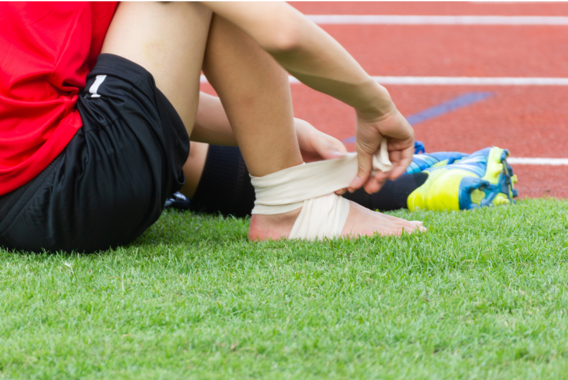
Ankle sprains happen on uneven winter ground, in tackles, or when someone lands on your foot. Roll one badly and the ligaments on the outside stay lax for months, which is why the same ankle keeps going. Calf strains climb sharply once you’re past 30, usually on a push-off in the back half of a game when fatigue has crept in. And knee injuries, including the ACL, tend to happen on a plant-and-pivot rather than in a tackle, often late, often when you’re tired and your landing mechanics have quietly fallen apart.
The pattern behind all of it is the same. Five days sitting, one night of explosive sport, no bridge in between. Your cardiovascular fitness comes back within a few weeks, which is the trap, because tendon and muscle tolerance takes considerably longer. You feel ready well before your tissue is.
How Osteopathic treatment actually does for this
An osteopath’s first job is to work out why the injury happened, not just where it hurts. A strained hamstring in a 38-year-old office worker is rarely a hamstring problem in isolation. More often it’s a stiff lower back, a hip that doesn’t extend properly, or glutes that have stopped contributing, and the hamstring has been quietly covering for all of it.
At a first appointment our practitioners will take a history of your training and your working week, then assess how you actually move. That means looking at hip and ankle range, spinal mechanics, how you load each leg, and where your movement is being blocked. The tissue that’s sore gets attention, but so does the thing that overloaded it.
Treatment itself is hands-on. Soft tissue work, joint articulation, stretching and manipulation where it’s appropriate, paired with specific loading exercises you take away with you. For a muscle strain, graded strengthening is what rebuilds the tissue’s tolerance. Passive treatment on its own feels good and doesn’t hold up.
The other half of the job is a realistic return-to-play plan. Coming back too early is the single biggest reason hamstring injuries recur, and the reinjury rate is high in people who go off feel alone.
What you can do before something goes
Most of this is unglamorous and it works.
Sprint before you have to sprint in a game. This is the one people skip. If your first maximal effort of the season happens in a match, your hamstrings are being tested cold. Do some build-up runs at 70, 80 then 90 per cent during the week. Two or three sessions is enough to change your risk meaningfully.
Do Nordic curls or a similar eccentric hamstring exercise. Two sets, twice a week. The evidence for eccentric hamstring work reducing strains is about as strong as anything in sports medicine, and it takes five minutes.
Warm up properly, not for show. Ten minutes minimum: easy jogging, leg swings, lunges, gradually faster runs. Static stretching alone before explosive sport doesn’t protect you.
Strengthen your glutes and adductors. Copenhagen planks for the groin, bridges and split squats for the glutes. If the hips do their share, the hamstrings stop overworking.
Respect the load. Going from nothing to twice a week plus a Sunday game is how people break. Add one session at a time.
And if something grabs mid-game, stop. Playing on through a hamstring twinge turns a two-week problem into a two-month one.
Melbourne in Winter: Cold ground, tired bodies
Timing works against you here. The World Cup finished in the middle of a Melbourne winter, so the surge of new players hits during the coldest, hardest weeks of the year. Muscles are less compliant in the cold. Grounds are either rock hard or churned to mud, and neither is kind to ankles and knees.
If you’re heading straight from a desk in the CBD to an indoor pitch in Docklands or a ground out past Essendon, you’ve likely been sitting for eight hours and had ten minutes in the car to prepare. Give yourself longer. Get moving before you arrive if you can, keep a layer on until you’ve actually broken a sweat, and treat the first fifteen minutes as part of the warm-up rather than part of the contest.
Indoor five-a-side deserves its own note. The surface grips, the space is tight, and the changes of direction are relentless. It’s excellent exercise and it’s harder on ankles and knees than the full-sized game. On a full pitch you get moments to jog and recover. On a small court you don’t, and the constant turning is what tends to catch people out.
Boots matter too, and most people play in whatever was in the shed. Screw-in studs on hard August ground give more grip than you want, which means more torque through the knee when you turn. Moulded boots or trainers on firm surfaces are the safer choice. If your boots are more than a few seasons old, check whether the studs have worn unevenly, because that quietly changes how your foot loads every step.
FREQUENTLY ASKED QUESTIONS
Q: What’s the difference between an osteopath and a physio for a hamstring strain? Both treat hamstring injuries well and there’s real overlap. Osteopaths tend to look more broadly at how the whole body is moving, so we’ll spend time on your lower back, pelvis and hip mechanics rather than only the injured muscle, on the basis that something caused the strain. Osteopathic treatment usually involves more hands-on work. In practice the best choice is often the practitioner you’ll actually keep seeing through your rehab.
Q: How many sessions will I need for a football injury? It depends on what you’ve done. A mild grade one hamstring or calf strain often settles over three or four sessions across a month or so, alongside exercises you do at home. A more significant tear, or a groin problem that’s been grumbling for a season, takes longer. We’ll give you a realistic estimate after the first assessment rather than an open-ended plan, and you should notice progress within the first two or three visits.
Q: Can a hamstring injury cause back pain, or the other way around? Frequently, and the relationship runs both ways. The hamstrings attach to the pelvis, so a stiff lower back or a pelvis that isn’t moving well changes how much work the hamstrings do. Some pain felt in the back of the thigh is actually referred from the lumbar spine or the sciatic nerve rather than a torn muscle at all. It’s one of the reasons we assess the back and pelvis routinely when someone comes in with a hamstring complaint.
Q: Is a football injury covered by private health or WorkCover? If you have extras cover that includes osteopathy, you can claim a rebate on the spot through HICAPS, and the amount depends on your fund and level of cover. A social football injury isn’t a WorkCover matter, since that covers injuries arising from your employment. If you did hurt yourself at work, or in a work-organised sporting event, tell us at booking and we’ll set the file up correctly from the start.
Contact our friendly Osteo team at MOSIC. We can help you prevent or recover from your injuries.
